
Free tool · 2-minute dating guide
How old is my tape, film or slide?
Pick your format, then scan the cues. Each cue narrows the date to a 5–10 year window — sometimes to the month, if you can read a Kodak edge code or a stamped slide mount.
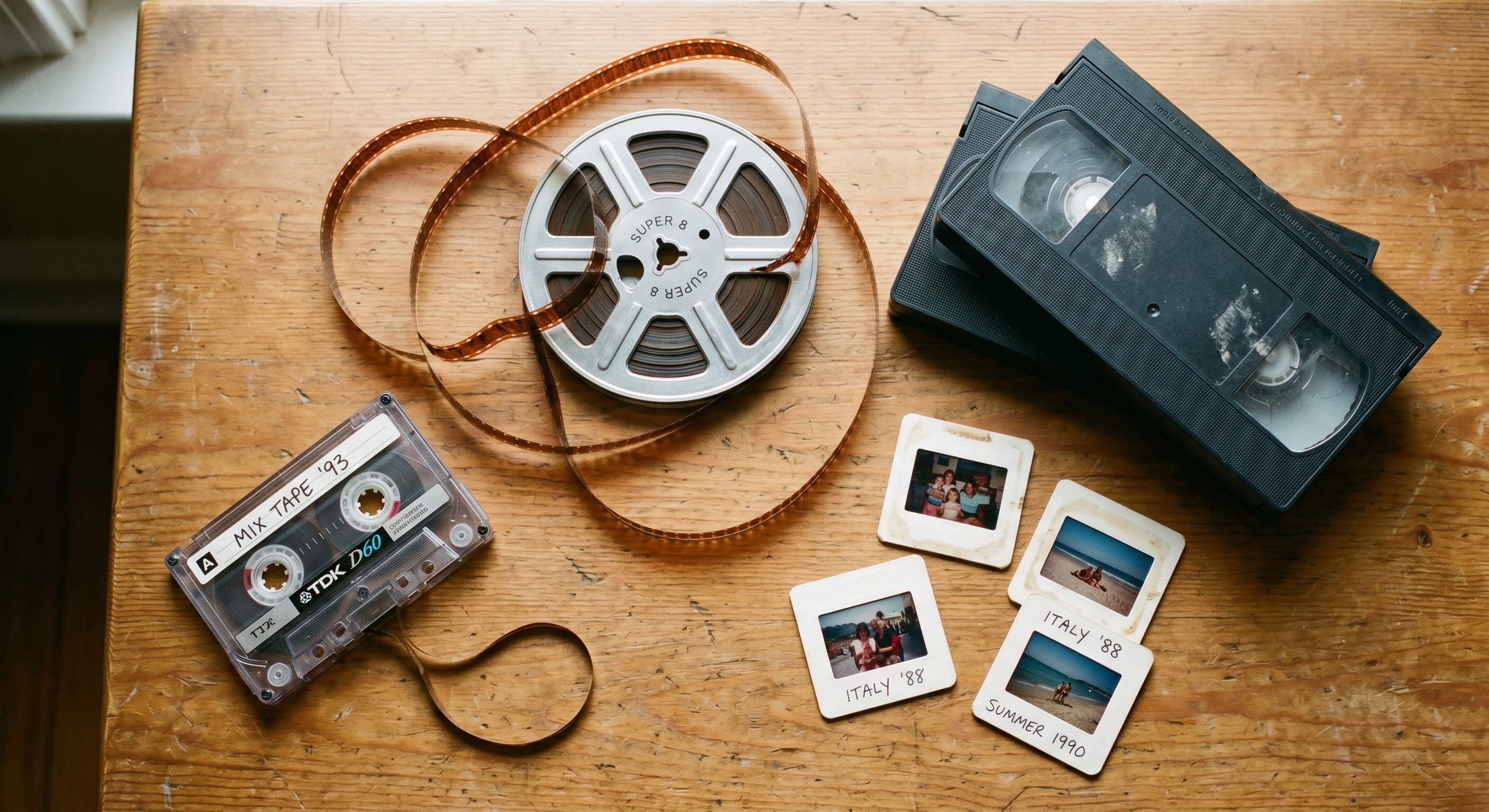
Cine film
Cine film often has its date stamped directly into the edge of the film by Kodak — see the "Kodak edge code" tip below the format cues. The cues here help when the edge code is unreadable or missing.

Super 8 with a magnetic sound stripe (rust-red band along one edge)
Narrow windowLikely era
1973 – late 1990s
Kodak introduced magnetic-striped Super 8 sound film in 1973. If your reel has a visible rust-red stripe down one edge, it cannot have been shot before then.
Super 8 silent reel or square cartridge, no sound stripe
Typical windowLikely era
1965 – mid-1970s (most likely)
Super 8 launched in 1965 and dominated home movies through the mid-1970s before video took over. Silent Super 8 stayed available after sound was introduced, but most silent Super 8 footage in family attics dates from this first decade.
Standard 8 (Regular 8 / 8mm) on open reels
Typical windowLikely era
1932 – mid-1960s (most likely)
Standard 8 was the dominant amateur format from the 1930s until Super 8 took over after 1965. Most surviving Standard 8 footage was shot between the 1940s and early 1960s — wartime weddings, post-war family holidays, classic British seasides.
9.5mm Pathé film (sprocket holes down the centre)
Typical windowLikely era
1922 – early 1960s
Pathé's 9.5mm format peaked between the wars and never fully recovered. Most surviving 9.5mm in UK family attics dates from the 1930s–1950s. If your reel is professionally-printed cinema content (early Disney shorts, newsreels, holiday films), the print date is usually within the original release decade.
16mm film on a 7″ or larger reel, amateur footage
Rough estimateLikely era
1923 – 1970s (most likely 1940s–1960s)
16mm was launched in 1923 as the first non-flammable amateur format. After WWII it was popular for schools, churches, corporate AV and well-off families. Most surviving consumer 16mm dates from the 1940s–1960s; after that it became almost entirely a professional / educational format.
16mm film with professional-looking title cards, broadcast leader or "TV use only"
Rough estimateLikely era
1950s – 1980s
Broadcast and educational 16mm peaked from the 1950s through the 1980s before video took over. If your reel has BBC, ITV or commercial broadcasting markings, the year of the recording is usually printed on the box or leader.
VHS
VHS as a consumer format ran roughly 1976–2006. Most tapes in family lofts were recorded between 1985 and 2000. Brand and label style narrow that down — typography evolved noticeably each decade.
Thick, blocky "VHS" logo with rounded edges; no Dolby marking
Narrow windowLikely era
1976 – early 1980s
Early VHS logos used a heavier, chunkier typeface. Dolby noise-reduction was rare on consumer VHS before 1985, so the absence of any Dolby logo is also a clue for the early period.
"VHS HiFi" or "Dolby" badge on the cassette label
Narrow windowLikely era
Mid-1980s – mid-1990s
VHS HiFi stereo launched in 1984. The "Dolby" badge appeared on consumer VHS in volume from 1985 onwards. If your tape has either, it is almost certainly post-1984.
Premium tape branding: "HG", "HQ", "Hi-Grade", "Extra HG", "Master"
Typical windowLikely era
Mid-1980s – late 1990s
Manufacturers introduced premium tape lines in the mid-1980s to differentiate from cheap blank tape. The fancier the branding (Master, Pro, Vision), the later the tape — these designations peaked between 1990 and 1998.
PAL length code: E-120, E-180, E-240, E-300
Rough estimateLikely era
Late 1970s – mid-2000s (UK / Europe)
E-series length codes are PAL (UK, Europe, Australia). They appeared from the late 1970s onwards. E-240 and E-300 (4 and 5-hour tapes) were less common before the mid-1980s, so seeing them often points later in the range.
Pre-recorded commercial VHS with studio packaging (Disney, Warner, etc.)
Rough estimateLikely era
1978 – mid-2000s
Pre-recorded VHS rental titles first appeared in 1978. The copyright date and "© Disney" / "© Warner" year on the packaging is usually accurate within a year of release.
Unbranded shell, hand-written paper label, no manufacturer logo at all
Rough estimateLikely era
1980s – 1990s (most likely)
Blank VHS recorded off-air at home almost always dates from the home-recording golden age, roughly 1985–2000. The label handwriting style sometimes betrays the decade more than the tape itself — biro on cream paper feels 1980s; thicker felt-tip on white feels 1990s.
Audio cassette
Compact cassettes ran 1963–early 2000s. The most reliable dating clues are the "Type" designation (introduced 1979) and any Dolby noise-reduction markings.
No "Type I/II/IV" marking anywhere, no Dolby logo
Typical windowLikely era
1963 – late 1970s
The "Type" designation was introduced in 1979 as part of the IEC cassette standardisation. Tapes that pre-date this often carry no Type marking and no Dolby logo (consumer Dolby B emerged in 1968 but took years to become standard).
Type I (Normal / Ferro) + Dolby B only
Narrow windowLikely era
Late 1970s – mid-1980s
Type I + Dolby B was the mainstream consumer combination from the late 1970s through the mid-1980s. If Dolby B is the only Dolby variant on the shell, you're probably in this window.
Type II (CrO₂ / Chrome / Cobalt)
Rough estimateLikely era
1970 – mid-1990s (most likely 1979 onwards)
CrO₂ chrome tape existed from 1970 but the "Type II" designation only standardised in 1979. Most Type II tapes in attics today are home-recorded mixtapes from 1980–1995.
Type IV (Metal)
Narrow windowLikely era
1979 – early 2000s
Metal tape launched in 1979 and was always the premium tier — expensive to manufacture, mostly bought by audiophiles. If you have Type IV tapes, you have a music enthusiast in the family.
"Dolby S" logo anywhere on the shell
Narrow windowLikely era
1989 – early 2000s
Dolby S noise reduction launched in 1989 as a consumer subset of Dolby SR. It was only ever fitted to higher-end consumer decks and tapes, so its presence both dates the tape and signals it was likely an enthusiast purchase.
Length codes C-30, C-60, C-90, C-120
Rough estimateLikely era
1963 – early 2000s
Length codes appeared from launch in 1963. C-120 (longer playing) used thinner tape and was less common before 1980 because of reliability issues. So C-120 in particular suggests post-1980.
Slides & Kodachrome
Slide mounts often carry the processing month and year stamped directly into the cardboard or plastic edge — this is the single most reliable dating clue available on any home-media format. Check the mount edges before reading the cues below.

Cardboard mount with thin paper insert; mount is matte and pale yellow / cream
Narrow windowLikely era
1939 – mid-1970s
Kodak used cardboard slide mounts as the default consumer mount from Kodachrome's 1936/1939 launch until the switch to plastic in 1976. Cardboard mounts cluster heavily in the 1950s–1960s peak of amateur slide photography.
Plastic mount, often grey-and-white, possibly with "Kodachrome 25" or "K-14" marking
Narrow windowLikely era
1976 – 2010
Kodak switched consumer slide mounts to plastic in 1976. Kodachrome itself was discontinued in 2009 and the last K-14 lab closed in 2010. Plastic-mounted Kodachrome lives in this window.
Mount has a printed month/year stamp on one of the edges
Narrow windowLikely era
Read it directly — usually accurate to the month
Kodak printed the processing month and year onto consumer slide mounts from the 1940s onwards. The format varies (e.g. "JUN 67" or "08 76") but is essentially always the processing date. The photo was taken in the days or weeks before that date.
Ektachrome (not Kodachrome) cardboard or paper mount
Typical windowLikely era
1946 – 1990s (most likely 1960s–1980s)
Ektachrome was Kodak's home-developable colour slide film. It became dominant for amateur slide photography in the 1970s–80s as Kodachrome processing became harder to find.
Black-and-white slide / monochrome transparency
Rough estimateLikely era
1930s – 1960s
Monochrome slide film was the dominant slide format from the 1930s until Kodachrome and Ektachrome took over after the war. Black-and-white amateur slides in UK attics are usually pre-1965.
Very small slide, much narrower than 35mm — 110 format
Typical windowLikely era
1972 – 1990s
Kodak's 110 pocket-camera format launched in 1972 and was hugely popular through the 1980s. Slide-style transparencies in 110 size are nearly always from this window.
Betamax
Betamax is easier to date than VHS because Sony was the only major manufacturer and the format had a clear consumer arc (1975–1988) before becoming a niche professional format.

Sony Betamax tape with "L-500", "L-750" or "L-830" length code
Narrow windowLikely era
1975 – late 1980s
L-series length codes are the standard consumer Betamax range. Sony stopped producing Betamax decks for the UK in 1989 and most consumer activity ended by then. Tapes in this range almost always date from 1975–1989.
"Betamax" in the original 1970s blocky logo, on a tape that looks slightly faded
Typical windowLikely era
1975 – 1985
The first-generation Betamax logo was used through the format's consumer peak. By the mid-1980s Sony was modernising the visual identity in response to VHS's dominance.
"ED Beta" or "ED Betamax" branding
Narrow windowLikely era
1988 – 1990s
ED (Extended Definition) Betamax launched in 1988 as Sony's upgrade for the prosumer market. It never sold well in the UK. ED Beta tapes are always 1988 or later.
"Betacam" or "Betacam SP" branding — yellow / orange edge band on the cassette
Rough estimateLikely era
1982 – 2000s
Betacam is the professional broadcast format derived from Betamax. If you have Betacam tapes, someone in the family likely worked in TV, news, or corporate AV. The exact era depends on the deck — Betacam SP launched in 1986 and was the broadcast standard well into the 2000s.
The one tip that beats all the others: Kodak edge codes
On Kodak cine film (Super 8, Standard 8, 9.5mm, 16mm), the edge of the film between frames carries a small repeating code printed by Kodak — usually two characters: a shape (●, □, △, ✕, etc.) and a letter. The shape repeats on a 10-year cycle and the letter cycles each year within that decade, so the combination pins the year of manufacture to a specific calendar year.
You'll typically need a loupe or magnifier and good light to read it, but if you can, the year is exact (rather than a 5–10 year guess). Same trick works on Ektachrome and other Kodak professional stocks. Once you have the manufacture year, the footage was almost always shot within a year or two.
Want these memories preserved before another 40 years pass?
Most tape and film in family attics is now at least 30 years old. Whatever date this guide settled on, the magnetic and chemical decay clock has been running. We digitise every major format with AI restoration included.
Get a quote